Follow me through my highs and lows as I attempt to teach English as a foreign language as a Peace Corps volunteer in Moldova
Showing posts with label students. Show all posts
Sunday, June 30, 2013
Wednesday, June 19, 2013
POTD 28: Balul Bobocilor
One of my favorite school concerts is called “Balul Bobocilor”, or the Freshmen Ball. This is a concert featuring either the 5th or 10th form, which are the youngest class of each school (middle and high school). The theme is ducklings. The class is split into two, and there is a cute competition between two groups. There’s usually a main couple (girl and boy) that represent each group, and each group presents a dance number, a singing number, and a skit, usually comedic. It’s actually pretty similar to most of the other concerts, but there’s the competition aspect and it’s usually a little funnier. At the end, the judges (usually 3 teachers) pick the winners.
Sunday, June 16, 2013
POTD 31: Homeworkopoly
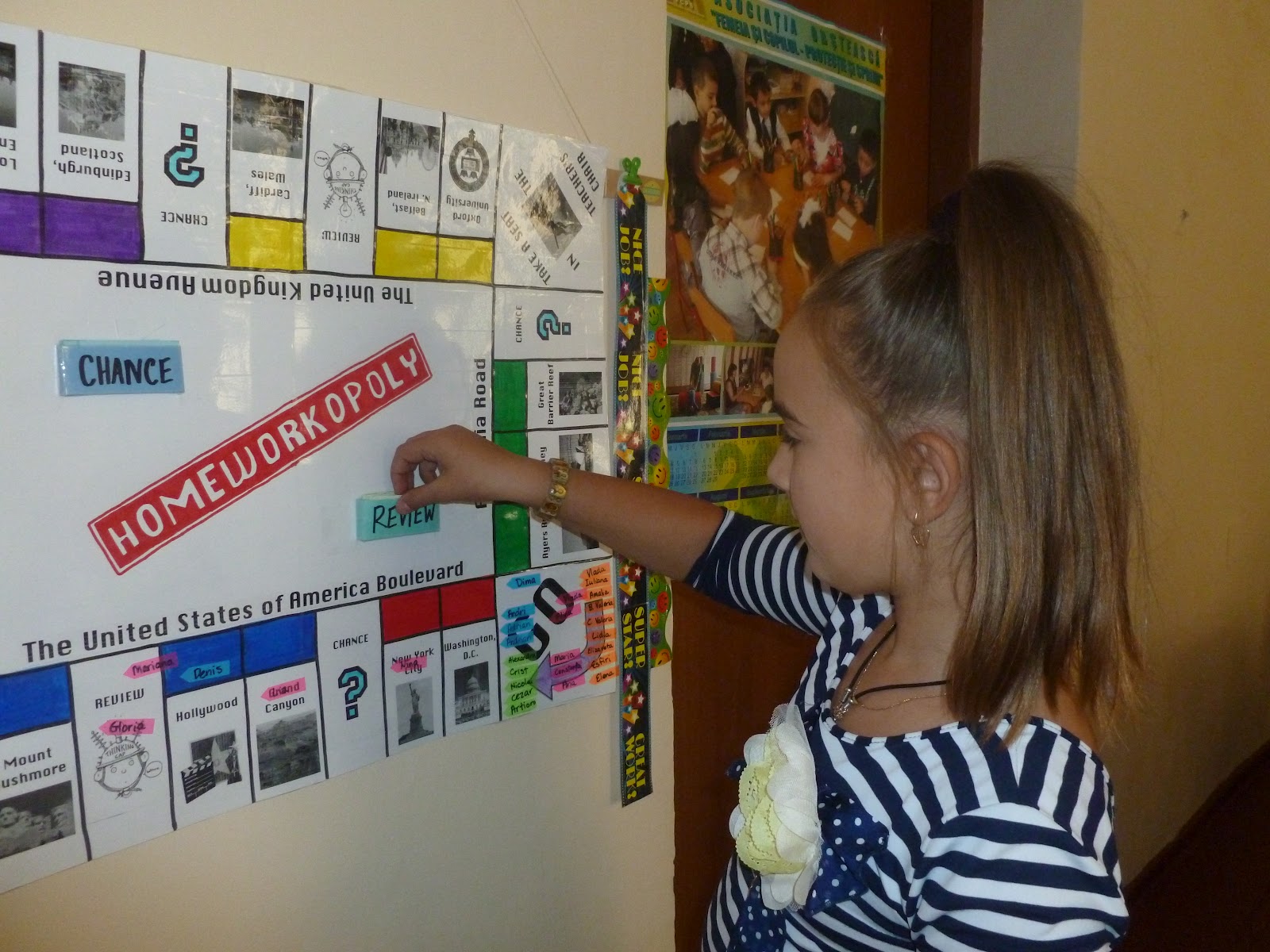
This was one of my favorite classroom
moments here: introducing Homeworkopoly to encourage completing homework in the
5th form class. The students were so excited about the game and
couldn’t wait to play. And when they saw that I wanted to take pictures, they
couldn’t wait to get their picture taken with the game. And as long as my
partner teacher and I kept up with using the game, a lot more students
completed their homework this year.
Thursday, May 30, 2013
POTD 48: 5th Form Girls
My two 5th form
classes probably have no idea that they have been what has made my second year easier.
I have loved working with these kids and always looked forward to lessons with
them. Today was our last day of classes, but of course, lessons didn’t happen; the students
had to clean the school. Luckily I was able to steal some time with each class
to share some cake and take pictures. Here are just some of those amazing
students.
Thursday, March 7, 2013
Serenity Prayer
God, grant me the serenity to accept the things I cannot change,
The courage to change the things I can,
And wisdom to know the difference.
I’ve always loved that prayer, and it never rang so true until I had this job. Everyday, I have to tell myself “You can’t do everything”, and everyday I try to prove this statement wrong. But I’m must face facts and be okay with not being able to fix everything.
It’s a real challenge picking what I can change and what I can’t. It’s like saying what do I care more about, or picking which problems are fixable as opposed to lost causes. It’s not always an easy decision. And finding the serenity to accept I can’t change certain things is difficult.
When PC first told me about my assignment, they told me that it was very likely I would see corporal punishment in the classrooms. Luckily, I haven’t seen that. But what is seen as acceptable for how people talk to each other is hard for me to handle. It’s acceptable for people to call each other stupid or yell at them to shut up; this goes for teacher-to-students as well as peer-to-peer. Anger is more often expressed. On numerous occasions, I’ve seen students cry and no one does anything about it.
There are also problems with way the education is valued (or not valued). Moreover, all the other problems I’ve mentioned before.
I end up putting a lot of energy into trying to inspire change with certain things without ever seeing a result. It’s very tiring. And although I know I must accept I can’t change everything, sometimes I wonder if it’s okay if I never stop trying to change certain things that may be impossible for me to change.
It’s a real challenge picking what I can change and what I can’t. It’s like saying what do I care more about, or picking which problems are fixable as opposed to lost causes. It’s not always an easy decision. And finding the serenity to accept I can’t change certain things is difficult.
When PC first told me about my assignment, they told me that it was very likely I would see corporal punishment in the classrooms. Luckily, I haven’t seen that. But what is seen as acceptable for how people talk to each other is hard for me to handle. It’s acceptable for people to call each other stupid or yell at them to shut up; this goes for teacher-to-students as well as peer-to-peer. Anger is more often expressed. On numerous occasions, I’ve seen students cry and no one does anything about it.
There are also problems with way the education is valued (or not valued). Moreover, all the other problems I’ve mentioned before.
I end up putting a lot of energy into trying to inspire change with certain things without ever seeing a result. It’s very tiring. And although I know I must accept I can’t change everything, sometimes I wonder if it’s okay if I never stop trying to change certain things that may be impossible for me to change.
Thursday, February 14, 2013
Sometimes You Need To Do Things For Yourself
If you are PCV, you have heard the word “sustainability” all too often. And although PC may overuse the word, I do actually think about the sustainability in everything I try to do here. It helps me decide what I want to take on and what I will and won’t do.
So as a rule of thumb, I aim to focus more on improving my partner teachers’ teaching skills more than my students’ education. My reasoning is that if I were to focus on the students, I would only influence the students I work with for these two years. But if I improve my partner teachers’ teaching skills, they will go on to continue to help students once I leave and provide good teaching techniques to future generations. So I’ll indirectly help students long after I’m gone.
Since I love teaching, sometimes this is difficult for my mentality. So I’ve decided to make an exception to my sustainability rule and work in small groups with some struggling students. As a result, I’m working less with my partner teacher during the lesson, and I’m creating resources on my own instead of teaching my partners how to make them. But I think I need this. I need a time when I can teach in my style without worrying about teaching my partners, when I get to enjoy teaching.
I really wish I’d thought of this earlier in my service because I’m loving it. I get to create my own lesson plan my way. I get to teach without worrying about my partner. And I get to get to know some of my students better. Plus, since I’m working with struggling students separately, I’m creating my own little curriculum. So I’m not restricted by the textbooks. And bonus, my Romanian is getting better.
So as a rule of thumb, I aim to focus more on improving my partner teachers’ teaching skills more than my students’ education. My reasoning is that if I were to focus on the students, I would only influence the students I work with for these two years. But if I improve my partner teachers’ teaching skills, they will go on to continue to help students once I leave and provide good teaching techniques to future generations. So I’ll indirectly help students long after I’m gone.
Since I love teaching, sometimes this is difficult for my mentality. So I’ve decided to make an exception to my sustainability rule and work in small groups with some struggling students. As a result, I’m working less with my partner teacher during the lesson, and I’m creating resources on my own instead of teaching my partners how to make them. But I think I need this. I need a time when I can teach in my style without worrying about teaching my partners, when I get to enjoy teaching.
I really wish I’d thought of this earlier in my service because I’m loving it. I get to create my own lesson plan my way. I get to teach without worrying about my partner. And I get to get to know some of my students better. Plus, since I’m working with struggling students separately, I’m creating my own little curriculum. So I’m not restricted by the textbooks. And bonus, my Romanian is getting better.
Thursday, February 7, 2013
Yep, I’m Still In Moldova
It’s been 20 months working and living in Moldova, and I feel pretty accustom to daily life here. In fact, that’s why I don’t have as many blog entries anymore. So you would think that most things wouldn’t surprise me much anymore, yet I still get caught off guard with some things.
On Monday, one of my partner teachers told a student to leave the lesson to go make copies since she hadn’t made them yet. This involved the student leaving the school to go to a place that makes copies. The student had to go multiple shops, and the student missed the whole lesson.
And in another class, we were giving a test. I caught a student cheating and marked that he would receive a lower grade because of it, which is something my partner and I have been doing all year. And he just left the classroom. As far as I can tell, he won’t be making up the test either.
And then today, I was talking to another one of my partners about how I could participate more in the lessons. In the classroom with this partner, I’ve been included less and less in the lessons slowly through out the year. At this point, I was pretty much just sitting there doing nothing the whole lesson. So I wanted to come up with a way to help out and participate more, and I suggested that I work with the students struggling with English in small groups or individually. My partner replied that she would love my help and that she hadn’t asked for my help before because she didn’t want to disturb me during the lesson. I guess that why I’m not always involved in the lesson. I don’t think she completely understands my purpose in working with her.
It’s experiences like this that make me miss America and American school systems. I miss valuing education, both from the teachers and students. I miss higher expectations in schools. I miss the expectation for working hard, from all members of the school community. And while America is far from perfect, I’m starting to get excited to get back to working in the familiarity of American schools.
On Monday, one of my partner teachers told a student to leave the lesson to go make copies since she hadn’t made them yet. This involved the student leaving the school to go to a place that makes copies. The student had to go multiple shops, and the student missed the whole lesson.
And in another class, we were giving a test. I caught a student cheating and marked that he would receive a lower grade because of it, which is something my partner and I have been doing all year. And he just left the classroom. As far as I can tell, he won’t be making up the test either.
And then today, I was talking to another one of my partners about how I could participate more in the lessons. In the classroom with this partner, I’ve been included less and less in the lessons slowly through out the year. At this point, I was pretty much just sitting there doing nothing the whole lesson. So I wanted to come up with a way to help out and participate more, and I suggested that I work with the students struggling with English in small groups or individually. My partner replied that she would love my help and that she hadn’t asked for my help before because she didn’t want to disturb me during the lesson. I guess that why I’m not always involved in the lesson. I don’t think she completely understands my purpose in working with her.
It’s experiences like this that make me miss America and American school systems. I miss valuing education, both from the teachers and students. I miss higher expectations in schools. I miss the expectation for working hard, from all members of the school community. And while America is far from perfect, I’m starting to get excited to get back to working in the familiarity of American schools.
Thursday, November 29, 2012
Special Education
Working in a foreign school system is difficult; I think that goes without saying. But one of the hardest things for me to deal with is the lack of recognition of students with special needs. People are different, and everywhere you go, people work differently. Classrooms everywhere are multilevel; you cannot escape that, no matter where you are. And Moldova is no exception. Just like in the States, there are a number of students with special needs. The unfortunate difference is that “special needs” is not as well recognized, and therefore, not accommodated for. Being a teacher who studied and worked in the USA, this is incredibly difficult for me to work with.
The most common need I see is students with AD/HD. So just to give you a quick background on my beliefs on students with AD/HD, I believe that AD/HD is a diagnosis that needs to be recognized and accommodated for. However, I believe that too many parents and teachers are using a diagnostic of AD/HD as a cop-out, thinking they just give their child Ritalin as a “fix” to the problem. Many cases only need teaching rather than treatment. With the right discipline and expectations, the child can learn (without medication) how to deal with AD/HD. However, that is not to say that I think all AD/HD diagnoses can be approached as such. There are many cases where a child needs a little bit more than the right teachings. But in many cases, I think the student just needs the right teacher.
The Moldavan school system does not work in a way that diagnoses students with specials needs. Additionally, the teachers do not receive training on how to work with students with special needs. And there aren’t special education teachers in the schools.
With an understanding of my philosophy and the Moldavan school system, you might be able to understand my personal dilemma. While I have several students who might be diagnosed with AD/HD, there is a student in my 5th form who clearly has AD/HD, possibly extreme enough to need medication (which says a lot coming from me).
Since I value teaching over treatment, I want to provide this student with the right kind of accommodations. But without all his other teachers helping and accommodating, I wonder how effective I can be. Furthermore, there is the need of sustainability from the work I do. So I have this internal battle: do I give him the time and attention he requires and hope my teacher learns from my example (which, so far, has not proven true in other situations, unfortunately), or should I focus on teaching my partners how to work with AD/HD and deny him some of the help he would get if I personally worked with him?
I don’t know the perfect answer to this, which is often the response I have to the dilemmas I have working in a foreign school system. I wish that answers to my problems could be more black and white. It would make this job so much easier. But if that were true, I guess they couldn’t advertise the Peace Corps as “the hardest job you’ll ever love”.
The most common need I see is students with AD/HD. So just to give you a quick background on my beliefs on students with AD/HD, I believe that AD/HD is a diagnosis that needs to be recognized and accommodated for. However, I believe that too many parents and teachers are using a diagnostic of AD/HD as a cop-out, thinking they just give their child Ritalin as a “fix” to the problem. Many cases only need teaching rather than treatment. With the right discipline and expectations, the child can learn (without medication) how to deal with AD/HD. However, that is not to say that I think all AD/HD diagnoses can be approached as such. There are many cases where a child needs a little bit more than the right teachings. But in many cases, I think the student just needs the right teacher.
The Moldavan school system does not work in a way that diagnoses students with specials needs. Additionally, the teachers do not receive training on how to work with students with special needs. And there aren’t special education teachers in the schools.
With an understanding of my philosophy and the Moldavan school system, you might be able to understand my personal dilemma. While I have several students who might be diagnosed with AD/HD, there is a student in my 5th form who clearly has AD/HD, possibly extreme enough to need medication (which says a lot coming from me).
Since I value teaching over treatment, I want to provide this student with the right kind of accommodations. But without all his other teachers helping and accommodating, I wonder how effective I can be. Furthermore, there is the need of sustainability from the work I do. So I have this internal battle: do I give him the time and attention he requires and hope my teacher learns from my example (which, so far, has not proven true in other situations, unfortunately), or should I focus on teaching my partners how to work with AD/HD and deny him some of the help he would get if I personally worked with him?
I don’t know the perfect answer to this, which is often the response I have to the dilemmas I have working in a foreign school system. I wish that answers to my problems could be more black and white. It would make this job so much easier. But if that were true, I guess they couldn’t advertise the Peace Corps as “the hardest job you’ll ever love”.
Friday, October 5, 2012
Teacher's Day
Today, my school celebrated World Teacher’s Day. It is quite a lovely thing to see the students honoring their teachers. Back in the States, we had Teacher Appreciation week, which seemed to be sponsored by the parents and school systems. Here, the students take the initiative to thank their teachers. It’s wonderful to see the students show their teachers they care.
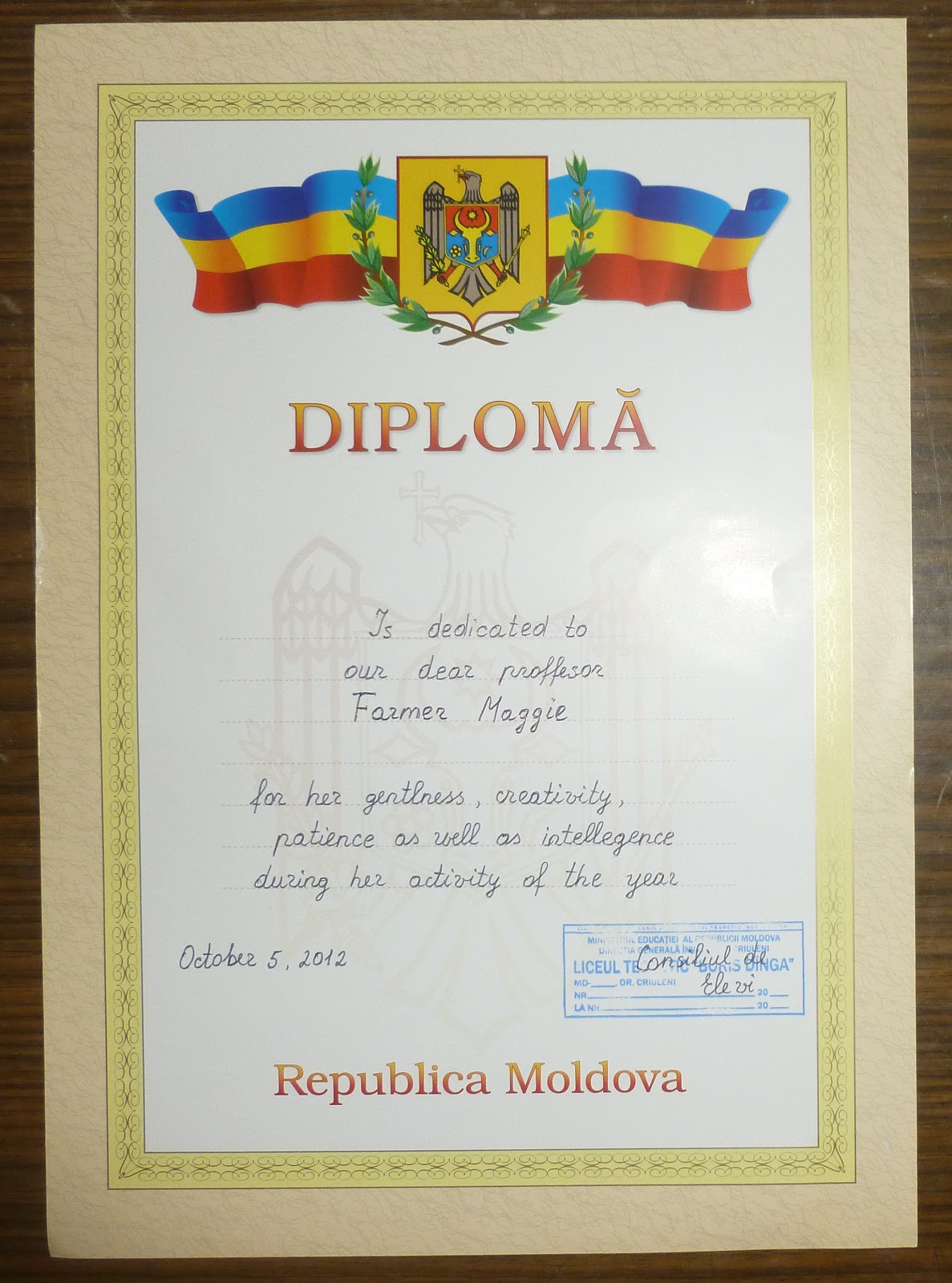
This year, the day began with a little assembly where a group of students thanked all the teachers. They presented each teacher (including me) with a rose and a certificate thanking the teacher for their hard work and dedication. The students even wrote my certificate in English.
The rest of the day had shorter
lessons so we could finish the day by noon. During the lessons, the students
would come to the teacher to give them gifts and thank them for being their
teacher. At the end of the day, all the teachers walked out of the building
with their hands full of flowers, kitchenware, and other miscellaneous gifts.
Once the lessons were over, the
administration had a small masă for the teachers, where they thanked the teachers
for their hard work and dedication. Overall, it was a really touching day
honoring the teachers!
Thursday, September 20, 2012
Motivating Students Is A Full-Time Job
With all the stress I’ve been experiencing while working with all my partners to set-up the English department room, I had started to forget how much I was looking forward to this new year. I mentioned my new plan about how I’m working with my partner as a resource teacher, meaning I will spend more time helping them develop resources to share in the English department. And even though Peace Corps haven’t approved my new work plan yet, it’s how I’m working right now. The school is still kind of chaotic since the class schedule isn’t finalized yet, so I’m working on resource development.
Early last week, I brought in a game I made for my 5th formers that encourages completing homework called “Homeworkopoly”. It’s a board game based on “Monopoly” that the students get to play when they completed their homework from the night before. There are various prizes that they can win throughout the game, most of which are privileges such as wearing a crown in class or sitting in the teacher’s chair. When I showed it to my partner Valentina, she was so excited. She said she loved it and couldn’t wait to use it. She was so happy to hang it in her classroom and she thought the students would love it. And just in case I had any doubt to the sincerity of her thanks, she gave me a hug for the first time as a result of me providing material for her classroom.
On Tuesday, we explained Homeworkopoly to the students, and their face just lit up with excitement. Positive reinforcement is not something typically seen in Moldova, so the students were surprised to hear they could earn prizes. They seemed particularly excited about singing the “Hokie Pokie” with me.
Early last week, I brought in a game I made for my 5th formers that encourages completing homework called “Homeworkopoly”. It’s a board game based on “Monopoly” that the students get to play when they completed their homework from the night before. There are various prizes that they can win throughout the game, most of which are privileges such as wearing a crown in class or sitting in the teacher’s chair. When I showed it to my partner Valentina, she was so excited. She said she loved it and couldn’t wait to use it. She was so happy to hang it in her classroom and she thought the students would love it. And just in case I had any doubt to the sincerity of her thanks, she gave me a hug for the first time as a result of me providing material for her classroom.
On Tuesday, we explained Homeworkopoly to the students, and their face just lit up with excitement. Positive reinforcement is not something typically seen in Moldova, so the students were surprised to hear they could earn prizes. They seemed particularly excited about singing the “Hokie Pokie” with me.
Today, we were finally able to really start playing Homeworkopoly. The students were so excited. They couldn’t believe they were being rewarded for completing their homework. The students who completed their homework were so proud to show it to me, and they would make the biggest grin when I would call them to come and play. There were several students who didn’t complete their homework, so they would worked on it in class and show it to me, hoping to get to play. I explained that they had to do their homework before class. Based on the responses today, I’m really hoping to see a lot more completed homework at the beginning of the next class.
Seeing my students so motivated
was incredible. I don’t see that too often here. Since I was able to spend my
time looking up ideas to use in the classroom, I was able to make something
that is new and effective in the classroom. Hopefully PC will approve my new
plan, and I can be working more with my partners to come up with these types of
ideas this year.
Monday, May 28, 2012
End of the Year
So the end of the school year is here. This is the last week of school. May 31 is the last day of classes. There are state exams for some grades, so those classes with continue to work with teachers to prepare for exams. However, this doesn’t affect me. I am done with lessons on May 31.
The end of the year is crazy; students are slightly apathetic and ready for school to be over, which is not too different than in schools in America. However, the biggest difference I noticed is the teachers don’t attempt to have any kind of lesson. For example, during the past two weeks, in my 10th form, my partner and I haven’t taught or reviewed anything. All we have done is allowed the students to get additional marks by speaking in English. Sometimes my partner will try to have a conversation with a student and give him/her a mark based on that. But most of the time, the students just recite a paragraph in English that they have memorized. Not really an accurate way to measure one’s knowledge of English.
All of my partners have been using lesson time during the last week as a way to get their grades done. They will assign the students a task, such as read the text or answer the questions, and then they will work on averaging the grades while the students “work”. While I don’t have a huge problem with assigning the students work so the teacher can work (mind you, I don’t really like this idea, but there are bigger issues I choose to help improve), my partners don’t hold the students accountable for the task. So basically, it’s just busy work.
Additionally, the students have now turned in their textbooks to their homeroom teachers. And since most of my partners plan by doing activities straight from the textbooks, lessons are pretty empty because my partners aren’t sure what to do without them. I’m trying to plan English activities and games for my students so the time in class is not completely wasted. However, it’s difficult to get time with my partners to plan together because they are so busy with the end of the school year. And since the whole point of PCVs working with partners is to create sustainable differences in the classroom, planning the activities alone seems in vain.
Furthermore, it’s difficult to keep the students’ attention. The students seem to like the activities, but most of them have checked out. They know their teachers aren’t holding them accountable for the information, so they really don’t try much.
In fact, I don’t think much is being done about attendance at this point either. I have noticed attendance is a problem all year around; the students just skip classes when they feel like it very frequently. However, today was a new situation. My first lesson only had about half the students present. And my last lesson today only had 3 students, one of which left after the first 10 minutes of class.
I’d hate to admit this, but I can’t help but wonder why we continue to have lessons if the students aren’t present (whether physically or mentally) and the teachers aren’t using lesson time to teach.
The end of the year is crazy; students are slightly apathetic and ready for school to be over, which is not too different than in schools in America. However, the biggest difference I noticed is the teachers don’t attempt to have any kind of lesson. For example, during the past two weeks, in my 10th form, my partner and I haven’t taught or reviewed anything. All we have done is allowed the students to get additional marks by speaking in English. Sometimes my partner will try to have a conversation with a student and give him/her a mark based on that. But most of the time, the students just recite a paragraph in English that they have memorized. Not really an accurate way to measure one’s knowledge of English.
All of my partners have been using lesson time during the last week as a way to get their grades done. They will assign the students a task, such as read the text or answer the questions, and then they will work on averaging the grades while the students “work”. While I don’t have a huge problem with assigning the students work so the teacher can work (mind you, I don’t really like this idea, but there are bigger issues I choose to help improve), my partners don’t hold the students accountable for the task. So basically, it’s just busy work.
Additionally, the students have now turned in their textbooks to their homeroom teachers. And since most of my partners plan by doing activities straight from the textbooks, lessons are pretty empty because my partners aren’t sure what to do without them. I’m trying to plan English activities and games for my students so the time in class is not completely wasted. However, it’s difficult to get time with my partners to plan together because they are so busy with the end of the school year. And since the whole point of PCVs working with partners is to create sustainable differences in the classroom, planning the activities alone seems in vain.
Furthermore, it’s difficult to keep the students’ attention. The students seem to like the activities, but most of them have checked out. They know their teachers aren’t holding them accountable for the information, so they really don’t try much.
In fact, I don’t think much is being done about attendance at this point either. I have noticed attendance is a problem all year around; the students just skip classes when they feel like it very frequently. However, today was a new situation. My first lesson only had about half the students present. And my last lesson today only had 3 students, one of which left after the first 10 minutes of class.
I’d hate to admit this, but I can’t help but wonder why we continue to have lessons if the students aren’t present (whether physically or mentally) and the teachers aren’t using lesson time to teach.
Wednesday, January 18, 2012
A Snow-Covered Cruileni
I woke up this morning to a beautiful white Criuleni. There has been a little snow here and there the last month, but nothing that was really sticking. This week though, the ground was frozen, and I had hoped that this meant snow would stick, which it did. It’s the perfect kind of snow, the kind that crunches underneath my feet. There is enough that it covers everything, but the trees aren’t hanging low because of how heavy it is.
The atmosphere seemed to change overnight. Criuleni was so happy today. December was a lot of rain and cold, so it was kind of dreary. But the snow brought lots of smiles and happiness. On my walk to school this morning, I saw lots of children playing together as they walked to school. As I passed the bus station, I heard a man singing loud for all to hear. During school, every boy spent every minute of every break outside playing in the snow. And on my way home, the students all ran and slid to see how far they could slide across the packed snow. I even saw an adult man trying to slide across the snow.
This snow was a perfect pick-me-up for all of Cruileni.
The atmosphere seemed to change overnight. Criuleni was so happy today. December was a lot of rain and cold, so it was kind of dreary. But the snow brought lots of smiles and happiness. On my walk to school this morning, I saw lots of children playing together as they walked to school. As I passed the bus station, I heard a man singing loud for all to hear. During school, every boy spent every minute of every break outside playing in the snow. And on my way home, the students all ran and slid to see how far they could slide across the packed snow. I even saw an adult man trying to slide across the snow.
This snow was a perfect pick-me-up for all of Cruileni.
Monday, January 9, 2012
Okay Moldova, I’ll Stay
Today was our first day back to school. And just like in America, it is difficult to go back. But this morning was particularly difficult. During the first period, I teach 10th form with my partner teacher, Valentina. However, she was absent today, and she had called Maria, one of my other partner teachers, and told her to give the students a test.
I hate giving tests. Since there are so many things I'm hoping to inspire to change, I have to prioritize which things to work on first, and test-taking is something I have decided to work on next year. The students talk, use their books, pass notes, use their cell phones, and pretty much any form of cheating you can think of. I’m about ready to pull my hair out when we give tests. But at least I have my partner teachers in the room to help keep some form of order. However, not this time. The students were worse than usual and very disrespectful towards me. At the end of this period, I walked out the classroom feeling beaten. And I experienced, for the first time, a genuine feeling of quitting.
Luckily, Moldova wants me to stay. Whenever I’m feeling low, Moldova knows and reminds me why I’m here. And this occasion was no different. The very next period, I went to co-teach 5th form with Svetlana, which is one of my favorite age groups. Right after the bell rang, Maria asked Svetlana to work with Valentina’s class since she was absent. So I was left to teach alone. It was wonderful. It’s hard to describe how happy this made me. I love teaching so much, and for the first time in seven months I got to work with the students exactly how I wanted. I walked out of the class with a huge smile on my face.
And this wasn’t the end of my successes that day. With another partner, Tatiana, I was introducing foldables (a 3-D graphic organizer) to the 8th form. This class can be chatty and silly, and they have a hard time focusing. But when I was teaching them the new vocabulary words using a foldable, every single one of them was focused and listening to what I was saying, even the student who has a learning disability. This is a rare occasion even in an American classroom.
So somehow, I started my day with feeling pretty much the worse I have felt since I have been here and walked out of that school feeling like I had just won an Olympic event. So thank you, Moldova. You successful made me remove all thoughts of going home early. I will stay, and I will succeed.
And this wasn’t the end of my successes that day. With another partner, Tatiana, I was introducing foldables (a 3-D graphic organizer) to the 8th form. This class can be chatty and silly, and they have a hard time focusing. But when I was teaching them the new vocabulary words using a foldable, every single one of them was focused and listening to what I was saying, even the student who has a learning disability. This is a rare occasion even in an American classroom.
So somehow, I started my day with feeling pretty much the worse I have felt since I have been here and walked out of that school feeling like I had just won an Olympic event. So thank you, Moldova. You successful made me remove all thoughts of going home early. I will stay, and I will succeed.
Saturday, December 24, 2011
Holiday Spirit
So the holiday season is starting to make me miss home. When Thanksgiving rolled around, no one celebrates it here, so there wasn’t a constant reminder that I’m not home for Thanksgiving. So Thanksgiving came and went without causing me too much homesickness.
But Christmas is a different story. Christmas here is celebrated on Old Christmas, January 7. And so far, it’s not nearly as commercial as it is in USA. I only started seeing Christmas decorations for sell about two weeks ago, and I only started seeing decorations put up last weekend. The nice thing about this is that I wasn’t being reminded that it’s Christmas time since October. But now that the decorations are starting to be displayed, it does make me miss home. However, Moldova once again aims to make me happy. Wednesday was Roman’s 60th birthday, so we had a celebration. We had dinner at the only restaurant in my village with lots of my host family’s friends. We ate, we drank, we talk, we danced. It was a lot of fun. Plus, I got a picture of my host parents. It’s not the picture I was hoping for, but I think it captures them perfectly: Roman causing trouble and Parascovia scolding him. I love this picture of them.
| My host family: sitting are my host mom, Parascovia, and my host dad, Roman. My host brother standing; he lives in Spain and he was visiting for Roman's birthday. |
Additionally, there was a school Christmas concert this week. Last weekend, some eighth grade girls asked me to sing with them in school concert. I said that I would, and we sang “Jingle Bell Rock” together on Thursday. The girls were very impressed that I had the words memorized by our second rehearsal, but I reminded them that I have been singing along with this song since I was a child.
| Me with my partner teacher, Svetlana, and the four girls who sang "Jingle Bell Rock" with me. Notice the silly American wearing her coat because she can't handle the Moldovan winter. |
Labels:
celebrations,
Christmas,
cold,
host family,
school,
singing,
students
Monday, December 19, 2011
Top 10 Ways To Deal With My Frustrations in Moldova
10. Snickers: Chocolate has the magical power to make you feel better. Plus, this is chocolate I recognize. Snickers here is the same as in The States. However, resorting to this method frequently can cause a stomachache. Not to mention that I don’t want the world to know the size of my frustrations based on the size of my hips. Therefore, I try not resort to this method as frequently.
9. Listen to Veggie Tales Christmas Album: Okay, I have to admit that this one is only on the list because I’m listening to it while I’m typing this. But it doesn’t change the fact that listening to this CD brought a smile to my face, and I instantly felt better. If you have heard this CD, you know what I’m talking about. So although this might be a seasonal solution, based on my experience, it is highly effective.
8. Dance party in my room: Sometimes, I just need to dance.
7. Talking with my students: I love hearing the students try to speak English. It always turns out to be some kind of Romanglish, but I can usually figure out what they mean. And it sure sounds funny. Plus, they always make me laugh.
6. Walks: A couple weeks ago, I started talking walks in the afternoon, and I have really come to enjoy them. I get to just relax and take in all that is Moldova. I try to walk a different way every day, so I get to see a part of Cruileni I haven’t seen before. It is really pleasant. Although sometimes I encounter other frustrations here, like the lovely smell of burning trash or being chased by stray dogs. But it’s only momentary.
5. Meeting new people: It helps remind me why I’m here. Plus, it can also be a little self-esteem boast. Moldovans often thank me for being here or compliment my initiative. Plus, who wouldn’t want to meet all sorts of people from a foreign land?
4. Spending time with my host family: Whether it’s talking to my host mom about my day at school or learning Russian with Roman over a shot (okay, several shots) of cognac, my host family never fails to put me in a better mood.
3. Coka Cola Light: I have to admit that I am dealing with my stress by drinking my weight in Coka Cola Light almost every day. But considering the fact that I am in the country that has the highest consumption of alcohol per capita, I think this little addiction I have developed for caffeine is an okay problem compared to what it could be.
2. Puppies: My host family’s dog had puppies several weeks ago. They are now big enough to come out and play. They are so little, and I love how they run up to me when I’m coming. The doghouse is right by the gate, so I pass them when I come home and when I’m leaving. I have learned that I have to leave an extra 5 minutes early to account for stopping to play with the puppies before I leave the house. Just look at them. How could this not melt all your problems away?
9. Listen to Veggie Tales Christmas Album: Okay, I have to admit that this one is only on the list because I’m listening to it while I’m typing this. But it doesn’t change the fact that listening to this CD brought a smile to my face, and I instantly felt better. If you have heard this CD, you know what I’m talking about. So although this might be a seasonal solution, based on my experience, it is highly effective.
8. Dance party in my room: Sometimes, I just need to dance.
7. Talking with my students: I love hearing the students try to speak English. It always turns out to be some kind of Romanglish, but I can usually figure out what they mean. And it sure sounds funny. Plus, they always make me laugh.
6. Walks: A couple weeks ago, I started talking walks in the afternoon, and I have really come to enjoy them. I get to just relax and take in all that is Moldova. I try to walk a different way every day, so I get to see a part of Cruileni I haven’t seen before. It is really pleasant. Although sometimes I encounter other frustrations here, like the lovely smell of burning trash or being chased by stray dogs. But it’s only momentary.
5. Meeting new people: It helps remind me why I’m here. Plus, it can also be a little self-esteem boast. Moldovans often thank me for being here or compliment my initiative. Plus, who wouldn’t want to meet all sorts of people from a foreign land?
4. Spending time with my host family: Whether it’s talking to my host mom about my day at school or learning Russian with Roman over a shot (okay, several shots) of cognac, my host family never fails to put me in a better mood.
3. Coka Cola Light: I have to admit that I am dealing with my stress by drinking my weight in Coka Cola Light almost every day. But considering the fact that I am in the country that has the highest consumption of alcohol per capita, I think this little addiction I have developed for caffeine is an okay problem compared to what it could be.
2. Puppies: My host family’s dog had puppies several weeks ago. They are now big enough to come out and play. They are so little, and I love how they run up to me when I’m coming. The doghouse is right by the gate, so I pass them when I come home and when I’m leaving. I have learned that I have to leave an extra 5 minutes early to account for stopping to play with the puppies before I leave the house. Just look at them. How could this not melt all your problems away?
1. Laughter: This is my main coping mechanism. I just laugh. I don’t what’s going, so I laugh. My partner teacher doesn’t like any of my ideas, so I laugh. It’s raining and I don’t have an umbrella and a 15-minute walk home. How about I laugh? I think I may come off as mad, but sometimes I have to laugh to avoid crying. It is my crutch.
Monday, December 12, 2011
My (Extra)Ordinary Day
My alarm goes off at 7:00. I debate pushing the snooze, but I remember I have already pushed it twice so I've slept 20 minutes more than I meant to, and I reluctantly get up. I go to the bathroom, wash my face, and brush my teeth without questioning using the water from the facet. I get dressed and pack my bag. I remember I'm in Moldova, so I shine my shoes, put on my leg warmers, and add an extra layer of clothes before walking out the door.
I walk out of my sleeping house onto a vacant street. It's one of those days where I want to stay snuggled up in bed with my cup of tea and watch old musicals. The sun has been totally blotted out by the abundance of clouds that have completely taken over the sky. The dark clouds seem to be threatening a rain that will not actually come. A flock of crows swarms across the grey sky, and I feel as if I am in a Hitchcock movie.
I make my way to the main street and finally see some sign of life. Men and women, bundled up in puffy coats, scarves, and caps without gloves, are walking in every direction getting ready for the working day. The old men stand together in groups of three or four, and look as if they don't have a care in the world as they watch the world pass them by. The young men huddle together, each with a cigarette in his hand while they listen to music blasting from one of their cell phones. The young women walk independently in every direction with great speed considering the fact they are wearing skin-tight jeans, four-inch heels, and carrying an oversized yet fashionable purse. The babas hobble by in oversized coats with a bright, colorful scarf tied around their heads. They carry the black lei bags full of their day's necessities. Their lifetime of hard work has made these women appear old and frail. But I know very well that not only do these women have great strength, but also they could easily drink me under a table without even trying.
A rutieră stops at the corner and several of my students step off. They flock together as if they were one unit as they hurry off in the direction of the school. A couple of the girls notice me and blush as they greet me with a shy "hello".
As I walk into the school, two lyceum students open the door and greet me with a mumbled "bună dimineața". On my way to the stairs, I pass a mirror hanging on the hall, and I can't help but notice my checks are a rosy pink from the cold, crisp, autumn air. I sigh at the thought that this is only autumn air; I have yet to experience the freezing air of a Moldovan winter morning.
I pass the school's maintenance man on my way upstairs to my first class. Without a change in facial expression, he taps his hat in recognition of me as I say a quiet “bună” before we continue our separate ways. Several students greet me with a quick "hello" as I walk down the hall to my class.
I get to my 10th form classroom, and I begin to prepare for the first lesson. My partner teacher for this lesson informs me that one of the other English teachers is sick today. Since the two classes combined won't fit in one classroom, she is going to work with the other class while I stay with our students. Great, I didn't prepare anything for the grammar part of this lesson because she was going to do that. My preparations for class quickly change to making a plan for teaching the grammar of this lesson.
The bells rings, and the students stand up. I greet the students before allowing them to sit. I ask the students how they are and what they did this weekend. Silence. I remind the students to use simple past tense. Silence. I tell them that I went for a walk this weekend, and I ask if anyone else went for a walk. Silence. The only reaction I get is the students slouching deeper and deeper in their seats trying to avoid eye contact with me while I try to help them form sentences. A boy comes into the classroom late, and the students all the sudden seem alive. He greets me and proceeds his way around the classroom making sure to shake the hand of every male there, no matter how difficult it is to get to him. Sometimes, the little things are the hardest things to work with.
I make it through the lesson and continue my day. I plan with another one of my teachers and introduce several ideas to try in our classroom. She only likes one idea if we change it slightly. Okay, I can compromise if it means I am introducing one new teaching method to the classroom. It’s all about taking baby steps. We finish planning before the bells rings and I leave for my next lesson.
I teach 8th form with yet another partner teacher, and we introduce a new grading rubric that requires more responsibility from the students. We get several groans, but the students seem to understand that they need to complete their homework from now on. I’m slightly upset that we are only now holding the students accountable for completing their homework. But I guess that’s why I’m here for two years; change takes time. And it requires a lot of patience from me.
I survive the rest of the day, despite the fact I feel like a human popsicle. These large concrete buildings can be really cold. As usual, everyone was wearing his or her coat and scarf all day, including me. It makes me wonder if I could stop worrying about dressing so nicely since I just wear my coat all day. But I conclude that this is Moldova; I must dress frumosly.
I start to walk home, and I get a text message. With much anticipation, I check to see who loves me so much that they decided to send me a text. My excitement is quickly replaced with disappointment as I read my message from Orange reminding me that I get 100% bonus calls on weekends if I recharge my account with 70 lei or more before December 20.
I come home to fresh pot of borș, which is large enough to last for my next three or four lunches. I put my bag away and sit down to lunch. My host dad walks back and forth between the kitchen and the backyard working on some project. Every time he passes, he is mumbling something in Russian.
I finish my lunch and head upstairs to start working. I sit down on my bed and spread out all my plans and textbooks. I open my laptop to pull up my lesson plans for tomorrow. I reread through my plans and begin making all the necessary material.
I work for about an hour, and then I notice that it is 3:30 and realize that if I want to go for a walk, I should leave now, before it gets dark. I head downstairs, all bundled up for my walk. I pass my host mom, and she asks me if I’m going for a walk. I tell her I am, and she laughs before telling me goodbye. I don’t know what is funny, and I head out the door without knowing.
I begin walking through my village, taking time to people watch. I really love walking through my village. I get to just observe Moldova. And I am able to remember why I’m here. Just as I begin to get lost in my thoughts, a man stops to talk to me. He speaks to me very quickly, and I can’t really understand. I did hear the words “work” and “police”, so I conclude that he works at the police station. I smile and try to converse before he continues on his way. I keep walking lost in thought most of the time, being distracted only every once in a while by scary dogs or the smell of burning trash.
I get home and sit down to work again. After 15 minutes, I remember that I have get ready to meet with some of my 10th form students I’m tutoring. I grab my tutoring material and leave for their house. The girls are waiting for me when I reach their house. We sit down and read “A Christmas Carol” together. I notice how much more quickly the girls are able to read through the book and how well the girls are understanding the text. It’s nice to see improvement in my students. I don’t always get to see this as well in the classrooms.
When we finish our lesson, we chat for a little bit, getting to know each other better before I leave for my house. I get home, and my host parents have already eaten. So I start to make myself dinner. I heat up a plate of leftover sărmale. I think about how I should have some starch with my meal, so I slice myself a piece of bread. When I finish my meal, I think about how the stuffing of sărmale is meat and RICE. I laugh at myself for thinking I needed bread. One of the many ways Moldova has rubbed off on me.
I clean my dishes and head up stairs to finish my planning. I have to plan for three lessons, finish preparing for two lessons the next day, and type up two lesson plans. I begin working, only occasionally getting distracted by the internet. Every once in a while I start to question if I’m working too hard or if my work will be done in vain since many things I make or plan don’t happen. But I try to reflect on the positive influences I have made so far, even though they are small. It’s just enough to motivate me to finish my work.
Once I finish my planning, it’s 9:00, which means I need to decide whether or not I need a shower. My hair doesn’t look too greasy, and I don’t smell too bad yet, so I decide the shower can wait another day. I start to get ready for bed before starting to type a blog for my website.
As I sit down and reflect on my day, I think about how plain it can seem. It’s not really what is often pictured when people think of volunteers in the Peace Corps. I don’t have this grand adventure everyday. I don't wake up worried about what poisonous insects might have crawled into my shoes. In fact, when it comes to necessities, my life is not much more difficult than my life in America. And yet, this has definitely been the toughest job I have ever had. I have to integrate into a new culture. I have to deal with requirements or expectations everyday that can be quite annoying. I am constantly challenged with obstacles that require me to be flexible or patient in ways I’m not used to. I have to push myself outside my comfort-zone all the time. But when I think about all of these challenges, I also know how much I have grown and matured while learning how to deal with these difficulties. I wonder…who is really getting the help, Moldova or me?
I walk out of my sleeping house onto a vacant street. It's one of those days where I want to stay snuggled up in bed with my cup of tea and watch old musicals. The sun has been totally blotted out by the abundance of clouds that have completely taken over the sky. The dark clouds seem to be threatening a rain that will not actually come. A flock of crows swarms across the grey sky, and I feel as if I am in a Hitchcock movie.
I make my way to the main street and finally see some sign of life. Men and women, bundled up in puffy coats, scarves, and caps without gloves, are walking in every direction getting ready for the working day. The old men stand together in groups of three or four, and look as if they don't have a care in the world as they watch the world pass them by. The young men huddle together, each with a cigarette in his hand while they listen to music blasting from one of their cell phones. The young women walk independently in every direction with great speed considering the fact they are wearing skin-tight jeans, four-inch heels, and carrying an oversized yet fashionable purse. The babas hobble by in oversized coats with a bright, colorful scarf tied around their heads. They carry the black lei bags full of their day's necessities. Their lifetime of hard work has made these women appear old and frail. But I know very well that not only do these women have great strength, but also they could easily drink me under a table without even trying.
A rutieră stops at the corner and several of my students step off. They flock together as if they were one unit as they hurry off in the direction of the school. A couple of the girls notice me and blush as they greet me with a shy "hello".
As I walk into the school, two lyceum students open the door and greet me with a mumbled "bună dimineața". On my way to the stairs, I pass a mirror hanging on the hall, and I can't help but notice my checks are a rosy pink from the cold, crisp, autumn air. I sigh at the thought that this is only autumn air; I have yet to experience the freezing air of a Moldovan winter morning.
I pass the school's maintenance man on my way upstairs to my first class. Without a change in facial expression, he taps his hat in recognition of me as I say a quiet “bună” before we continue our separate ways. Several students greet me with a quick "hello" as I walk down the hall to my class.
I get to my 10th form classroom, and I begin to prepare for the first lesson. My partner teacher for this lesson informs me that one of the other English teachers is sick today. Since the two classes combined won't fit in one classroom, she is going to work with the other class while I stay with our students. Great, I didn't prepare anything for the grammar part of this lesson because she was going to do that. My preparations for class quickly change to making a plan for teaching the grammar of this lesson.
The bells rings, and the students stand up. I greet the students before allowing them to sit. I ask the students how they are and what they did this weekend. Silence. I remind the students to use simple past tense. Silence. I tell them that I went for a walk this weekend, and I ask if anyone else went for a walk. Silence. The only reaction I get is the students slouching deeper and deeper in their seats trying to avoid eye contact with me while I try to help them form sentences. A boy comes into the classroom late, and the students all the sudden seem alive. He greets me and proceeds his way around the classroom making sure to shake the hand of every male there, no matter how difficult it is to get to him. Sometimes, the little things are the hardest things to work with.
I make it through the lesson and continue my day. I plan with another one of my teachers and introduce several ideas to try in our classroom. She only likes one idea if we change it slightly. Okay, I can compromise if it means I am introducing one new teaching method to the classroom. It’s all about taking baby steps. We finish planning before the bells rings and I leave for my next lesson.
I teach 8th form with yet another partner teacher, and we introduce a new grading rubric that requires more responsibility from the students. We get several groans, but the students seem to understand that they need to complete their homework from now on. I’m slightly upset that we are only now holding the students accountable for completing their homework. But I guess that’s why I’m here for two years; change takes time. And it requires a lot of patience from me.
I survive the rest of the day, despite the fact I feel like a human popsicle. These large concrete buildings can be really cold. As usual, everyone was wearing his or her coat and scarf all day, including me. It makes me wonder if I could stop worrying about dressing so nicely since I just wear my coat all day. But I conclude that this is Moldova; I must dress frumosly.
I start to walk home, and I get a text message. With much anticipation, I check to see who loves me so much that they decided to send me a text. My excitement is quickly replaced with disappointment as I read my message from Orange reminding me that I get 100% bonus calls on weekends if I recharge my account with 70 lei or more before December 20.
I come home to fresh pot of borș, which is large enough to last for my next three or four lunches. I put my bag away and sit down to lunch. My host dad walks back and forth between the kitchen and the backyard working on some project. Every time he passes, he is mumbling something in Russian.
I finish my lunch and head upstairs to start working. I sit down on my bed and spread out all my plans and textbooks. I open my laptop to pull up my lesson plans for tomorrow. I reread through my plans and begin making all the necessary material.
I work for about an hour, and then I notice that it is 3:30 and realize that if I want to go for a walk, I should leave now, before it gets dark. I head downstairs, all bundled up for my walk. I pass my host mom, and she asks me if I’m going for a walk. I tell her I am, and she laughs before telling me goodbye. I don’t know what is funny, and I head out the door without knowing.
I begin walking through my village, taking time to people watch. I really love walking through my village. I get to just observe Moldova. And I am able to remember why I’m here. Just as I begin to get lost in my thoughts, a man stops to talk to me. He speaks to me very quickly, and I can’t really understand. I did hear the words “work” and “police”, so I conclude that he works at the police station. I smile and try to converse before he continues on his way. I keep walking lost in thought most of the time, being distracted only every once in a while by scary dogs or the smell of burning trash.
I get home and sit down to work again. After 15 minutes, I remember that I have get ready to meet with some of my 10th form students I’m tutoring. I grab my tutoring material and leave for their house. The girls are waiting for me when I reach their house. We sit down and read “A Christmas Carol” together. I notice how much more quickly the girls are able to read through the book and how well the girls are understanding the text. It’s nice to see improvement in my students. I don’t always get to see this as well in the classrooms.
When we finish our lesson, we chat for a little bit, getting to know each other better before I leave for my house. I get home, and my host parents have already eaten. So I start to make myself dinner. I heat up a plate of leftover sărmale. I think about how I should have some starch with my meal, so I slice myself a piece of bread. When I finish my meal, I think about how the stuffing of sărmale is meat and RICE. I laugh at myself for thinking I needed bread. One of the many ways Moldova has rubbed off on me.
I clean my dishes and head up stairs to finish my planning. I have to plan for three lessons, finish preparing for two lessons the next day, and type up two lesson plans. I begin working, only occasionally getting distracted by the internet. Every once in a while I start to question if I’m working too hard or if my work will be done in vain since many things I make or plan don’t happen. But I try to reflect on the positive influences I have made so far, even though they are small. It’s just enough to motivate me to finish my work.
Once I finish my planning, it’s 9:00, which means I need to decide whether or not I need a shower. My hair doesn’t look too greasy, and I don’t smell too bad yet, so I decide the shower can wait another day. I start to get ready for bed before starting to type a blog for my website.
As I sit down and reflect on my day, I think about how plain it can seem. It’s not really what is often pictured when people think of volunteers in the Peace Corps. I don’t have this grand adventure everyday. I don't wake up worried about what poisonous insects might have crawled into my shoes. In fact, when it comes to necessities, my life is not much more difficult than my life in America. And yet, this has definitely been the toughest job I have ever had. I have to integrate into a new culture. I have to deal with requirements or expectations everyday that can be quite annoying. I am constantly challenged with obstacles that require me to be flexible or patient in ways I’m not used to. I have to push myself outside my comfort-zone all the time. But when I think about all of these challenges, I also know how much I have grown and matured while learning how to deal with these difficulties. I wonder…who is really getting the help, Moldova or me?
Wednesday, December 7, 2011
I Never Go To Bed Upset
This is no easy job; I am challenged every day in ways that no job has ever challenged me before. Patience and flexibility are demanded from me everyday, two virtues I could always use improvement on. Most days I can handle these challenges. But some days, the normal everyday things are just a little hard to handle.
So today was one of the difficult days. There was nothing particularly terrible; most things were normal (for Moldova). But I was just having a hard time dealing with it. One of my partner teachers was not noticing how distracted the students were during our lesson. Several students were playing games on their cell phone, and a couple of students were working on homework for another class. I walked around the room to help eliminate this problem, but it frustrated me that she didn’t notice. I also was upset with myself because I don’t know how to teach “with-it-ness”.
And then when I was talking with another partner, she said that she wanted to change tomorrow's lesson plan so that we review material from the last lesson. While I was happy she was telling me she was changing the plan (she changes it a lot without telling me), I was slightly annoyed that she was changing it to something I suggested in our last planning time. When I had suggested it, she said a very strong ‘no’ and moved on without considering. I know, I sound like a child, but I had spent time making the material for the lesson we had planned and now we were changing it…to something I had suggested previously.
A lot of times when I’m working with my partner teachers and we are compromising, I feel like I’m the only one compromising. The logical side of me knows this can’t be true, but my ideas sure get a lot of no's and I feel like I just offer suggestions to improve their ideas. I guess with compromising, you always feel like you are getting the short end of the stick.
Anyways, I ended up going home kind of melancholy. But the nice thing about Moldova is that it seems to want me to be happy. My bad days never stay bad for the whole day, like today. I am tutoring two 10th form students, and it has become one of my favorite activities I do here. The girls want to learn English and they give me respect. Plus I like developing personal relationships with the students that I don’t get to do as well in the classroom.
So when we finished our lesson today, the girls asked me to stay for some cake and tea. I of course accepted, and we sat together eating our cake and drinking our tea. One of the girls’ mother and brother joined us. We all started talking, and I soon found myself smiling and happy. We were talking in Romanian, so I didn’t understand everything, but I was enjoying myself. The girl’s mother was very friendly and kind to me, paying me several compliments and giving her gratitude for me helping her daughter. We all talked and laughed and just had a good time.
I think the thing I like most about being in Moldova is that for all the complaints I have, I have just as many, if not more, great things to say about it.
So today was one of the difficult days. There was nothing particularly terrible; most things were normal (for Moldova). But I was just having a hard time dealing with it. One of my partner teachers was not noticing how distracted the students were during our lesson. Several students were playing games on their cell phone, and a couple of students were working on homework for another class. I walked around the room to help eliminate this problem, but it frustrated me that she didn’t notice. I also was upset with myself because I don’t know how to teach “with-it-ness”.
And then when I was talking with another partner, she said that she wanted to change tomorrow's lesson plan so that we review material from the last lesson. While I was happy she was telling me she was changing the plan (she changes it a lot without telling me), I was slightly annoyed that she was changing it to something I suggested in our last planning time. When I had suggested it, she said a very strong ‘no’ and moved on without considering. I know, I sound like a child, but I had spent time making the material for the lesson we had planned and now we were changing it…to something I had suggested previously.
A lot of times when I’m working with my partner teachers and we are compromising, I feel like I’m the only one compromising. The logical side of me knows this can’t be true, but my ideas sure get a lot of no's and I feel like I just offer suggestions to improve their ideas. I guess with compromising, you always feel like you are getting the short end of the stick.
Anyways, I ended up going home kind of melancholy. But the nice thing about Moldova is that it seems to want me to be happy. My bad days never stay bad for the whole day, like today. I am tutoring two 10th form students, and it has become one of my favorite activities I do here. The girls want to learn English and they give me respect. Plus I like developing personal relationships with the students that I don’t get to do as well in the classroom.
So when we finished our lesson today, the girls asked me to stay for some cake and tea. I of course accepted, and we sat together eating our cake and drinking our tea. One of the girls’ mother and brother joined us. We all started talking, and I soon found myself smiling and happy. We were talking in Romanian, so I didn’t understand everything, but I was enjoying myself. The girl’s mother was very friendly and kind to me, paying me several compliments and giving her gratitude for me helping her daughter. We all talked and laughed and just had a good time.
I think the thing I like most about being in Moldova is that for all the complaints I have, I have just as many, if not more, great things to say about it.
Monday, December 5, 2011
I Can’t Even Say Their Names Right
So today, I messed up on 2 of my students’ names. I didn’t have their names wrong; I just don’t say them correctly. I don’t usually say someone’s name unless I’m sure what it is and I have never been corrected before, so this did come as a little surprise. And sadly, when one of my students was telling me how I say “Maxim” correctly, I heard no difference between what she said and what I say. And apparently the way I say “Nicu” is so funny, that Nicu couldn’t read the text when I called on him because he was laughing so hard, along with the rest of the class. I asked my partner teacher how I’m saying it wrong, and she said that I say it fine. I guess the students just like to have a laugh at the American.
Wednesday, November 9, 2011
Happy Dance
I’m tutoring two girls in my 10th form right now before I get an English club started, and one of the students mentioned she has difficulty with English in class. She went on to say that she was also scared in class. Not exactly the feelings I was hoping for. And I haven’t even started to become very strict yet. I’m trying to make change slowly so as the students and teachers adjust more easily. So I haven’t started becoming harsh for completing homework or not cheating with school work. Lordy.
But it’s all good now. We were chatting with the girls today, and they started to ask me about why I was here and such. When I told them I would be staying here for 2 years, one of the girls did a little happy dance. It was very cute. I liked getting this reaction better than hearing that I was scaring one of my students.
Friday, October 21, 2011
Can the American Catch Me?
My partner teachers seem to be very one minded; they are standing at the front of the room giving the lecture. They do not notice or choose to ignore the students who are not focused or playing with other items. I see it often, and I do not ignore this. When a cell phone is out, I make them put it in their pocket. If they are drawing, I take their picture. If they have another class’s textbook or homework, I tell them to put it away. Overall, I think I catch most actions.
I could tell the students were not used to being caught with their homework or cell phone (or whatever else they were doing in class) right away. For the first month, the students looked so shocked that I noticed they were texting in class or doing another class’s homework. They were not used to the teacher noticing. The funny thing is that they weren’t even trying to hide it. They would have their cell phone out and on their desk and were surprised I noticed.
Now that most of them know I am correcting the behavior, they try to be more discreet when doing something they are not supposed to. The key word here is ‘try’. The younger students might fold their arm and lay their head across their desk in a way that I can’t see what they are doing. But they are obviously doing something. And the older students hold their cell phones in their lap and pull the textbook close the edge of their desk so it looks like they are looking at their textbook. But obviously they are not completely focused on reading their English textbook (unfortunately), not to mention they are staring in their lap, not their desk.
The funny part of this is that many now almost make a game of it. They know I will catch them and tell them to put it away. So while they’re “being sneaky”, they stare at me until I catch them. Then when I see them, they innocently smile and pretend like they were behaving well the whole time. And many times, they wait until I stop looking at them and start again. Most days, I find this almost amusing.
Today was particularly funny. One of my 6th graders was drawing in class. After playing “can the American catch me” for several rounds, I took his paper. He no longer thought it was funny and started to pout. He then laid his head on the table and began to fake cry. And I mean fake cry like in cartoons; it was a rather pitiful attempt. I had to be really careful about not laughing at him because it really was quite humorous. It was even harder not to laugh because the rest of the students knew I had upset him. And they would look at him and then at me and laugh.
Anyways, as amusing as this all is, I really am hoping that I am teaching the students to focus on English when in English class. Constantly correct this behavior can be a little tedious, especially since I’m the only one doing it. But I’m hoping my partners will become more aware of the students’ behavior by watching me correct it, and eventually be correcting it themselves.
I could tell the students were not used to being caught with their homework or cell phone (or whatever else they were doing in class) right away. For the first month, the students looked so shocked that I noticed they were texting in class or doing another class’s homework. They were not used to the teacher noticing. The funny thing is that they weren’t even trying to hide it. They would have their cell phone out and on their desk and were surprised I noticed.
Now that most of them know I am correcting the behavior, they try to be more discreet when doing something they are not supposed to. The key word here is ‘try’. The younger students might fold their arm and lay their head across their desk in a way that I can’t see what they are doing. But they are obviously doing something. And the older students hold their cell phones in their lap and pull the textbook close the edge of their desk so it looks like they are looking at their textbook. But obviously they are not completely focused on reading their English textbook (unfortunately), not to mention they are staring in their lap, not their desk.
The funny part of this is that many now almost make a game of it. They know I will catch them and tell them to put it away. So while they’re “being sneaky”, they stare at me until I catch them. Then when I see them, they innocently smile and pretend like they were behaving well the whole time. And many times, they wait until I stop looking at them and start again. Most days, I find this almost amusing.
Today was particularly funny. One of my 6th graders was drawing in class. After playing “can the American catch me” for several rounds, I took his paper. He no longer thought it was funny and started to pout. He then laid his head on the table and began to fake cry. And I mean fake cry like in cartoons; it was a rather pitiful attempt. I had to be really careful about not laughing at him because it really was quite humorous. It was even harder not to laugh because the rest of the students knew I had upset him. And they would look at him and then at me and laugh.
Anyways, as amusing as this all is, I really am hoping that I am teaching the students to focus on English when in English class. Constantly correct this behavior can be a little tedious, especially since I’m the only one doing it. But I’m hoping my partners will become more aware of the students’ behavior by watching me correct it, and eventually be correcting it themselves.
Subscribe to:
Posts (Atom)